Commercial Janitorial Services vs Residential Cleaning: A 2026 Guide
Last Updated: October 23, 2026
Quick Summary
Commercial janitorial is business-to-business cleaning delivered by trained, insured crews under a written service agreement, usually after hours, while residential cleaning serves homeowners and renters on a schedule built around a household’s routine. The two differ in scope, frequency, equipment, staffing, and legal obligations, so buyers should match the provider to the facility type.
- Commercial janitorial covers restroom sanitation, floor care, trash removal, and high-touch disinfection under a recurring contract.
- Residential crews usually work in teams of two to three cleaners and finish a home in a single visit.
- Office cleaning cost per square foot is driven by square footage, frequency, facility type, task complexity, and labor conditions.
- A commercial cleaning contract should define scope, schedule, service levels, pricing, term, and termination in writing.
- Ask for proof of general liability and workers’ compensation insurance before signing with any provider.
Table of Contents
- Commercial Janitorial Services vs Residential Cleaning: Key Differences
- What Is Commercial Janitorial Services?
- What Is Residential Cleaning?
- Side-by-Side Comparison: Tasks, Frequency, and Equipment
- Office Cleaning Cost per Square Foot: What Drives the Price
- Building a Commercial Cleaning Checklist
- Setting a Janitorial Cleaning Schedule
- Understanding the Commercial Cleaning Contract
- Frequently Asked Questions
Commercial Janitorial Services vs Residential Cleaning: Key Differences
Commercial janitorial services and residential cleaning differ in three core ways: who performs the work, how often it happens, and what the job legally requires. Commercial janitorial is business-to-business cleaning delivered by trained crews on a contract, usually after hours, under insurance and safety obligations. Residential cleaning is homeowner-facing work, typically scheduled around a family’s routine. This guide from Bettermark Home & Property Services, LLC breaks down both sides so you can buy the right service instead of guessing.
The distinction matters more than most people expect. A homeowner who hires a commercial janitorial company for a move-out deep clean often pays for contract overhead they don’t need. A business owner who books a residential cleaner for a 4,000-square-foot office usually ends up with a crew that lacks the equipment, insurance, and staffing depth for the job.
What Is Commercial Janitorial Services?
Commercial janitorial services is the ongoing cleaning and maintenance of business facilities, delivered under a service agreement by trained, insured staff.
The scope is broader than most people assume. A commercial cleaning checklist typically includes restroom sanitation, floor care, trash removal, dusting of high-touch surfaces, breakroom cleaning, and interior window cleaning.
What separates janitorial services from general commercial cleaning is routine. Janitorial work is the recurring maintenance layer: daily, weekly, or biweekly visits that keep a facility presentable.
Facility type drives the plan. A dental office needs disinfection protocols a warehouse doesn’t. A retail store cares about entry glass and fitting rooms. Property managers juggling tenant turnovers need move-out cleaning between leases.
What Is Residential Cleaning?
Residential cleaning is professional cleaning of homes, apartments, and condos for the people who live there. The work focuses on kitchens, bathrooms, bedrooms, and living areas, and it’s usually scheduled around the household’s routine rather than a business calendar.
Home cleaning scope leans toward the surfaces residents touch and see. Dusting, vacuuming, mopping, kitchen wipe-downs, restroom sanitation, and bed making are standard. Deep cleaning adds baseboards, inside appliances, blinds, and behind furniture, and it’s often booked seasonally or at move-in and move-out.
The labor model is different in a way that matters. Residential crews usually work in smaller teams, often two to three cleaners, and complete a home in a single visit.
Background checks deserve a mention here because it’s the question we hear most. When you let a cleaning provider into your home, screening and a satisfaction guarantee with free re-cleaning are the two protections that actually matter.
Side-by-Side Comparison: Tasks, Frequency, and Equipment
The clearest way to see the difference is to line up the three variables buyers care about: what gets cleaned, how often, and with what.
| Factor | Commercial Janitorial | Residential Cleaning |
|---|---|---|
| Primary client | Businesses, property managers, offices | Homeowners, renters, families |
| Typical schedule | Daily, weekly, or biweekly recurring service, often after hours | Weekly, biweekly, or monthly, plus one-time deep cleans |
| Core tasks | Restroom sanitation, floor care, trash removal, high-touch disinfection, breakroom cleaning | Dusting, vacuuming, mopping, kitchen and bath cleaning, bed making |
| Equipment | Commercial vacuums, floor buffers, auto scrubbers, ride-on machines for large square footage | Residential vacuums, mops, hand tools, portable extractors |
| Staffing | Trained crews, supervisors, coverage for callouts | Small teams, often the same cleaner each visit |
| Contract | Written service agreement with scope and service levels | Per-visit or recurring booking, often no long contract |
| Insurance and compliance | General liability, workers’ comp, safety training, chemical handling rules | Varies widely; ask for proof of insurance |
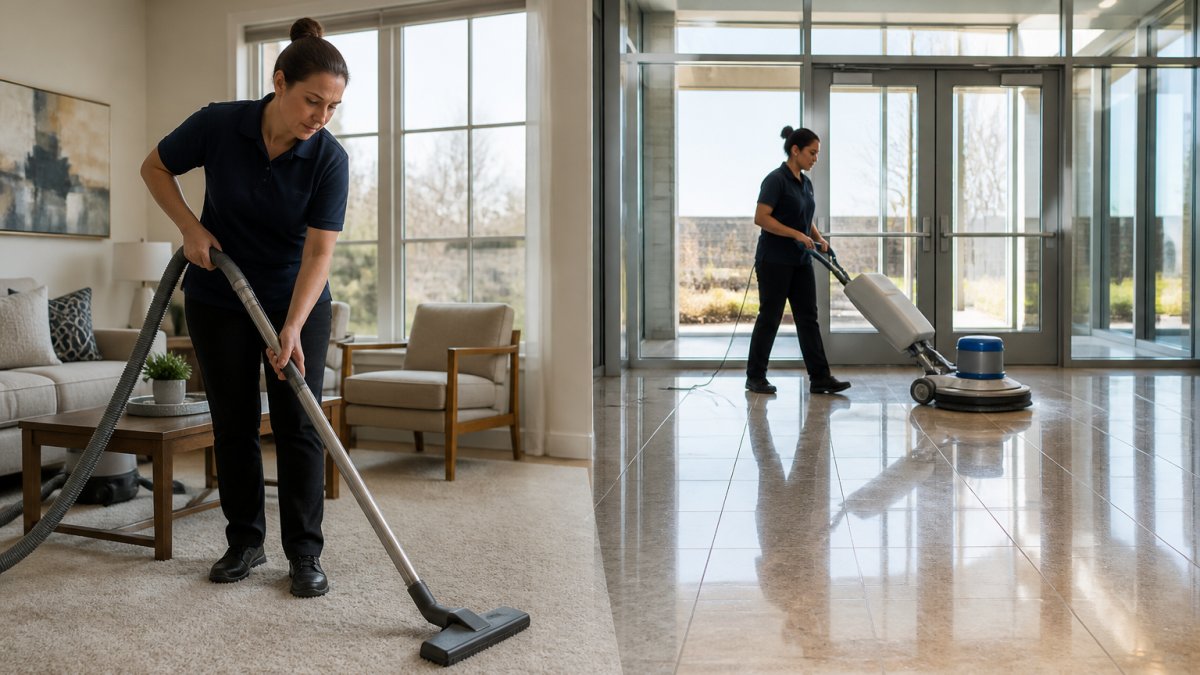
The equipment gap is the one buyers underestimate. Commercial equipment is built for square footage and durability: wide-deck vacuums, floor machines, and chemical dispensers sized for a building. Residential equipment is lighter and quieter, designed to fit around furniture and not disturb a household.
If a provider quotes your office without asking about square footage, traffic counts, or hours of operation, the number is a guess. A real commercial walkthrough takes 20 minutes and produces a written scope.
Frequency follows the same logic. High-traffic areas in a retail space may need daily cleaning, while a small professional office can run on three visits a week. Homes rarely need daily service unless someone has health or mobility needs that require it.
Office Cleaning Cost per Square Foot: What Drives the Price
Office cleaning cost per square foot is driven by five inputs: total square footage, cleaning frequency, facility type, task complexity, and labor market conditions. There’s no single national rate worth quoting, because the same square footage can cost twice as much depending on what’s inside it.
Here’s how each driver moves the number:
- Square footage: Larger spaces lower the per-square-foot rate because setup and travel time spread across more area.
- Frequency: Daily service costs more per month than weekly, but the per-visit rate often drops with a recurring schedule.
- Facility type: Medical, dental, and food-service spaces carry disinfection and compliance requirements that add labor time.
- Task complexity: Floor stripping and waxing, carpet extraction, and high dusting are priced as add-ons, not base scope.
- Labor requirements: Wages, payroll taxes, insurance, and supervision are the bulk of any janitorial bid. Cheap quotes usually cut here first.
Residential pricing works differently. Home cleaning is usually quoted per visit or per hour, based on bedrooms, bathrooms, and condition. A move-out deep clean costs more than a recurring maintenance clean of the same home because it takes longer.
Bettermark Home & Property Services, LLC does not publish fixed rates, and we’d be skeptical of any provider who does without seeing your space. Pricing depends on square footage, frequency, and scope, so ask for a walkthrough and a written quote.
The most common pricing mistake is comparing a two-page commercial bid to a one-line residential quote. The commercial bid includes insurance, supervision, and supply costs; the residential quote may include none of them. Compare scope line by line, not totals.
Building a Commercial Cleaning Checklist
A commercial cleaning checklist should be built room by room and task by task, then tied to a frequency for each item. Generic checklists fail because they ignore how a specific facility actually gets used.
Use this structure as a starting point:
- Restrooms: fixtures, mirrors, dispensers, floors, trash, restock supplies (daily)
- Entryways and lobbies: glass, floor mats, hard floors, high-touch handles (daily)
- Workstations and common areas: desks, conference tables, chair rails, light switches (daily or weekly)
- Breakrooms: counters, sinks, appliance exteriors, floors, trash (daily)
- Floor care: vacuuming, mopping, spot treatment (daily); extraction and buffing (monthly or quarterly)
- High dusting: vents, ceiling corners, light fixtures (monthly or quarterly)
- Interior windows and partitions (weekly or monthly)
- Supply restocking and inventory check (per visit)
Two rules make a checklist actually work. First, assign a frequency to every line, because “as needed” is not a standard. Second, name who verifies completion. A checklist nobody inspects is decoration.
For property managers handling tenant turnovers, the checklist shifts toward move-out cleaning: inside cabinets and appliances, inside closets, baseboards, and any damage documentation. That’s a different job from routine maintenance cleaning and should be scoped separately.
Setting a Janitorial Cleaning Schedule
A janitorial cleaning schedule should match cleaning frequency to traffic and risk, not to habit. The right schedule is the cheapest one that keeps the facility consistently presentable and compliant. Most commercial facilities land on one of four patterns.
- Daily cleaning: Best for high-traffic areas, restrooms in shared buildings, medical and food-service spaces, and any site open to the public.
- Weekly cleaning: Fits small offices and low-traffic professional suites where surfaces stay clean for several days.
- Biweekly cleaning: Works for satellite offices, storage-adjacent spaces, and sites with light occupancy.
- Monthly or quarterly deep cleaning: Covers the periodic work daily service skips, like carpet extraction, floor stripping, and high dusting.
After-hours cleaning is the default for most offices because it avoids disrupting staff and lets crews use loud equipment. Retail spaces often need a split: overnight floor care plus a daytime touch-up on restrooms and entry glass.
Build the schedule around three questions. When is the space empty? Which areas get the most traffic? What periodic work needs a calendar slot? Answer those and the frequency writes itself.
The best janitorial schedule isn’t the most frequent one. It’s the one that matches cleaning frequency to actual traffic and pairs daily maintenance with a calendar for periodic deep cleaning, so nothing gets deferred indefinitely.
Understanding the Commercial Cleaning Contract
A commercial cleaning contract should define scope, schedule, service levels, pricing, term, and termination in writing.
What to check before signing:
- Scope of work: Every task and its frequency, attached as an exhibit. If it isn’t listed, it isn’t included.
- Service-level expectations: How performance is measured and what happens when a standard is missed. Look for a re-clean clause and a response time.
- Insurance and liability: General liability coverage, workers’ compensation, and who covers damage to property. Ask for certificates, not verbal assurances.
- Compliance: Chemical handling, safety training, and any facility-specific requirements such as medical or food-service protocols.
- Pricing and adjustments: The base rate, what triggers a change, and how supply costs are handled.
- Term and termination: Length, renewal terms, notice period, and exit conditions.
- Staffing and screening: Who works on site, how they’re screened, and how callouts are covered.
The insurance question is where cheap bids fall apart.
We’d also push back on any contract that locks scope to a fixed visit time rather than a defined task list. Time-based scope rewards speed over results.
Bettermark Home & Property Services, LLC serves both sides of this divide: recurring home cleaning for households and commercial janitorial for offices, retail spaces, and rental turnovers.
If you’re weighing a residential or commercial provider, get a walkthrough and a written scope first. Then compare line by line.
Frequently Asked Questions
What is the difference between commercial janitorial services and residential cleaning?
Commercial janitorial services focus on business facilities like offices, retail spaces, and workplaces, covering tasks such as restroom sanitation, floor care, and after-hours cleaning. Residential cleaning serves homes and apartments with dusting, vacuuming, and kitchen cleaning. The key differences are scope, frequency, equipment, and contract terms. Commercial work often requires trained staff, commercial-grade supplies, and compliance with safety regulations, while residential cleaning is typically more flexible and task-specific.
How often should a business schedule janitorial services?
Frequency depends on facility type and traffic. High-traffic areas like restrooms and lobbies may need daily cleaning, while offices might use weekly or biweekly service. A janitorial cleaning schedule should match your commercial cleaning checklist and service-level expectations. Many businesses choose after-hours cleaning to avoid disrupting operations. Adjust frequency based on square footage, occupancy, and seasonal demands, and review the schedule quarterly with your provider.
Is commercial cleaning more expensive than residential cleaning?
Commercial cleaning typically costs more overall due to larger square footage, specialized equipment, and insurance requirements. Office cleaning cost per square foot varies by market, facility type, and service frequency. Residential cleaning is usually priced per visit or hourly. For a fair comparison, request a customized quote based on your specific needs. Remember that commercial contracts often include recurring service, compliance, and liability coverage, which affect pricing.
Do commercial cleaners use different equipment and products than residential cleaners?
Yes, commercial cleaners often use heavy-duty equipment like floor buffers, carpet extractors, and industrial vacuums, along with commercial-grade disinfectants and sanitizers. Residential cleaners typically use portable vacuums, mops, and household cleaning products. Commercial supplies must meet safety and environmental standards for workplaces, and some providers offer eco-conscious options. The equipment difference reflects the scale and intensity of cleaning required in commercial facilities.
What should I look for in a commercial cleaning contract?
A commercial cleaning contract should specify the scope of work, cleaning schedule, pricing model, term length, termination clauses, insurance requirements, and service-level expectations. Look for details on liability coverage, bonding, and compliance with regulations. Ensure the contract includes a commercial cleaning checklist and provisions for quality inspections. Review renewal terms and any additional fees. A clear contract protects both parties and sets measurable performance standards.
