Best Commercial Cleaning for Retail Stores: 2026 Guide
Table of Contents
- What to Look for in Commercial Cleaning for Retail Stores
- Quick Comparison: Commercial Cleaning Options for Retail
- Retail Cleaning Checklist: What a Proper Service Covers
- Building a Retail Store Cleaning Schedule That Works
- Commercial Cleaning Cost for a Retail Store: What Drives Pricing
- Questions to Ask a Commercial Cleaning Company Before You Sign
- Frequently Asked Questions
Last Updated: October 14, 2026
What to Look for in Commercial Cleaning for Retail Stores
Finding the best commercial cleaning for retail stores starts with understanding that your sales floor is a showroom, not an office. A missed dust line on a display shelf or a sticky patch near the register costs you sales in a way a cluttered desk never would.
Commercial cleaning is the scheduled professional service of maintaining a business facility’s floors, surfaces, restrooms, and waste systems to a defined standard. For retail, that standard is higher because customers judge the store before they judge the product.
Start your search with these non-negotiables:
- Retail-specific experience. A crew that only cleans offices will miss glass, entryways, and fixture dusting.
- Documented quality control. Ask for site inspection reports with actual scores, not verbal promises.
- After-hours capability. Your cleaning should never overlap with shopping hours.
- Background-checked staff. Teams handle cash-adjacent areas and back rooms.
Retail-Specific Selection Criteria
Generic janitorial checklists miss what matters most in a store. Prioritize providers who can show you a written scope that names your fixtures, fitting rooms, and display glass separately from general dusting. Ask how they handle high-traffic areas during holiday peaks, and whether they adjust service frequency without renegotiating the whole contract. The U.S. Small Business Administration guidance on choosing vendors offers a useful framework for vetting service contracts before you commit.
Ask any provider to walk your store with you at closing time before quoting. The walkthrough reveals whether they notice baseboards, entry mats, and under-shelf dust, which tells you more than any brochure.
Quick Comparison: Commercial Cleaning Options for Retail
Retailers generally choose between four service models, and each fits a different store size, budget, and oversight capacity. The right pick depends on your square footage, traffic volume, how many locations you operate, and how much day-to-day management you can absorb.
| Option | Best For | Typical Scope | Oversight Needed | Relative Cost |
|---|---|---|---|---|
| Independent cleaner | Small boutiques under 2,000 sq ft | Basic daily tasks, trash, restrooms, floors | High, you manage scheduling and quality | Lowest |
| Local cleaning company | Single storefronts, 2,000-10,000 sq ft | Full janitorial scope plus periodic deep cleaning | Medium, monthly check-ins | Mid |
| Regional janitorial firm | Multi-location chains | Standardized programs, reporting, account manager | Low, quarterly reviews | Highest |
| Day porter service | High-traffic stores, malls, flagship locations | Continuous upkeep during business hours | Low, often layered on a nightly contract | Add-on cost |
How to read the trade-offs.
- Independent cleaners cost the least but carry the most operational risk. If your only cleaner calls out sick the morning of a holiday sale, you have no coverage. They also rarely carry general liability coverage at the levels a landlord or mall operator may require, verify certificates before signing.
- Local cleaning companies hit the sweet spot for most single-storefront retailers. You get a supervisor, backup staff, and a written scope, but you still deal with the owner directly, which usually means faster answers than a regional firm’s ticket system.
- Regional janitorial firms make sense once you have three or more locations and need the same standard everywhere. You trade flexibility and price for consistency, documented inspections, and a single point of contact. Expect longer contract terms and less willingness to customize per store.
- Day porter service is not a replacement for nightly cleaning, it is an add-on. A porter handles spills, restroom checks, entry glass, and trash during shopping hours so your store stays presentable between deep cleans. High-traffic locations and mall tenants usually need both.
A quick decision rule. If you have one store under 5,000 sq ft and can supervise, a local company is usually the best fit. If you have multiple locations and no on-site manager, a regional firm’s reporting structure earns its premium.
Ask each provider to quote the same written scope so you can compare apples to apples. A low bid often reflects a shorter task list, not a better rate.
Matching the Model to Your Store Format
Store format matters as much as square footage. A jewelry boutique with glass cases and mirrored surfaces needs different labor than a big-box pet supply store with concrete floors and heavy foot traffic. Before you pick a model, list the surfaces and fixtures unique to your format, display glass, fitting room mirrors, produce misters, freezer aisles, and confirm the provider has cleaned that format before.
Retail Cleaning Checklist: What a Proper Service Covers
A retail cleaning checklist should cover every customer-facing surface plus the back-of-house areas shoppers never see but inspectors do. Without a written checklist, quality drifts within weeks.
Here’s the area-by-area breakdown we use when scoping a storefront:
- Sales floor: vacuuming, mopping hard floors, dusting fixtures and shelving, glass and mirror cleaning, spot treatment on upholstery
- Entryway: window cleaning, mat rotation, door hardware disinfection, tile cleaning
- Restrooms: restroom cleaning, disinfecting, restocking supplies, waste removal
- Fitting rooms: mirror polishing, floor vacuuming, sanitizing hooks and benches
- Checkout and counters: surface disinfecting, register-area dusting, trash removal
Disinfecting and sanitizing are not the same task. Disinfecting kills pathogens on a surface; sanitizing reduces bacteria to a safe level. High-touch spots like door handles and card readers need disinfecting, while most shelving only needs sanitizing.
Skipping restroom and fitting room logs is the most common compliance gap we see. Health inspectors and corporate auditors ask for dated cleaning records, and “we clean it daily” without documentation can trigger a violation.
Building a Retail Store Cleaning Schedule That Works
A retail store cleaning schedule works when it matches traffic patterns instead of forcing a fixed routine.
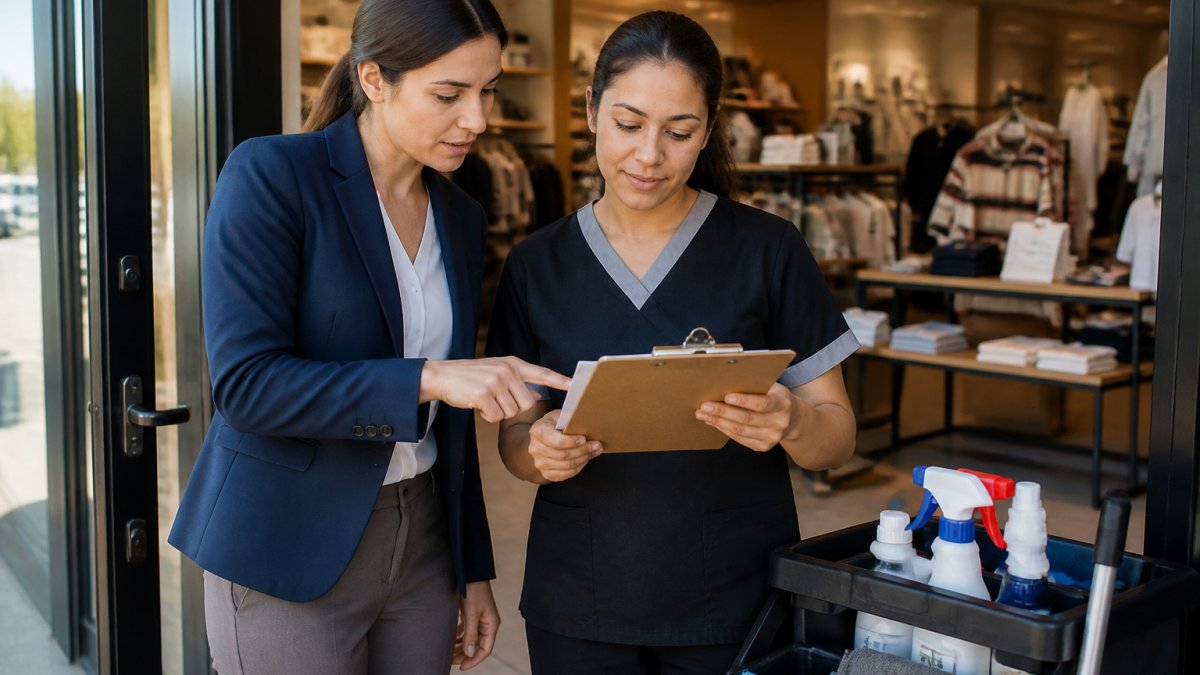
Daily tasks keep the store presentable: restroom cleaning, floor mopping, entry glass, waste removal, and spot vacuuming in high-traffic areas.
After-hours cleaning prevents disruption. A crew working from 9 p.m. to midnight finishes before your morning open, and a day porter covers spills and restroom checks during business hours.
Match frequency to foot traffic, not to calendar habit. A store doing 500 transactions a day needs daily floor care; a low-traffic boutique can stretch some tasks to twice weekly without visible decline.
Commercial Cleaning Cost for a Retail Store: What Drives Pricing
Commercial cleaning cost for a retail store depends on square footage, traffic volume, service frequency, and task complexity, not on a flat industry rate. Two stores of identical size can quote very differently, and most published “average cost per square foot” figures are too broad to be useful. What actually helps is understanding how a provider builds the number, so you can compare quotes and negotiate scope.
How Providers Build a Quote
Most commercial cleaning quotes are built from three components:
- Recurring labor, the hours per visit multiplied by the crew’s hourly rate, multiplied by visits per month.
- Supplies and consumables, paper products, liners, chemicals, and restroom stock, often billed as a flat monthly line.
- Periodic and specialty tasks, carpet extraction, floor stripping and waxing, high window cleaning, and deep cleans, quoted separately because they do not happen every visit.
Ask for the quote broken into those three lines. A single lump-sum number hides where the cost actually lives and makes it impossible to trim scope later without renegotiating the whole contract.
The Main Cost Drivers
- Square footage. Larger sales floors take longer to service, but cost per square foot usually drops as size increases because travel and setup are spread across more area.
- Frequency. Daily service costs more than three visits per week, but the per-visit rate often falls with higher frequency because the crew stays in a routine.
- Floor type. Carpet requires vacuuming and periodic extraction; tile and grout require mopping plus periodic deep cleaning; polished concrete needs different equipment entirely. Mixed flooring adds time.
- Restroom count. Each restroom adds supplies, labor, and compliance documentation. Restrooms are consistently the most labor-intensive area per square foot in any retail space.
- After-hours premiums. Late-night or early-morning windows can carry surcharges, especially in markets where overnight labor is harder to staff.
Questions That Reveal the Real Price
A low headline number often hides costs that appear later. Ask these before you sign:
- Is the quote all-inclusive or labor-only? Supplies and consumables can add a meaningful monthly line.
- What triggers a price increase? Annual escalators, fuel surcharges, and holiday premiums should be disclosed up front.
- What is the contract term and cancellation notice? Month-to-month with 30-day notice is common; 12-month terms with 60- or 90-day notice are not unusual for regional firms.
- What is excluded? Exterior windows, parking lot sweeping, grease traps, and pest control are frequently excluded from standard janitorial scope.
- How are add-on tasks billed? Per-event, per-hour, or folded into a change order, get the rate in writing.
How to Compare Quotes Fairly
Give every provider the same written scope of work, the same visit frequency, and the same access window. Then compare on three axes: total monthly cost, the itemized breakdown, and what is excluded. The lowest total is not always the best value, a quote that omits restroom supplies or periodic carpet care will look cheaper until the first invoice with add-ons arrives.
Be cautious of quotes that are dramatically below the others. In cleaning, an unusually low bid usually means fewer labor hours, thinner insurance coverage, or workers paid off the books, all of which shift risk back onto you as the store owner.
Where to Get Real Numbers
Because pricing is local and scope-specific, national averages are a weak guide. The most reliable path is to request itemized quotes from two or three providers who have walked your store. The U.S. Small Business Administration guidance on choosing vendors recommends getting multiple written bids and checking references before committing, which applies directly to cleaning contracts. If you operate multiple locations, ask for per-store pricing rather than a blended rate so you can see which sites are driving cost.
Questions to Ask a Commercial Cleaning Company Before You Sign
The questions you ask before signing separate a reliable service from a recurring headache. Get answers in writing, not over the phone.
- Who actually cleans my store? Ask whether the same trained cleaning staff return each visit or if crews rotate.
- How do you measure quality? Request sample site inspection reports and service standards.
- What’s your insurance and bonding status? Verify coverage before anyone enters your store.
- How do you handle callouts? A backup plan keeps your store covered when a cleaner is sick.
- Can you scale for peak season? Holiday traffic may require extra visits.
- What’s the cancellation and re-cleaning policy? Confirm what happens if a clean falls short.
- Do you offer eco-conscious products? If odors or sensitivities matter, ask about low-odor options.
The U.S. Occupational Safety and Health Administration guidance on cleaning chemicals is worth reviewing so you understand which products require safety data sheets on site. A professional provider should supply those without being asked.
Stores that need consistent quality across multiple locations and can’t supervise a crew daily.
Running a storefront means every customer forms an opinion in the first ten seconds, and a dull floor or smudged entry glass undoes good merchandising fast. Bettermark Home & Property Services, LLC builds customized cleaning plans around your traffic, your schedule, and your fixtures, with background-checked providers, eco-conscious product options, and a satisfaction guarantee backed by free re-cleaning.
Frequently Asked Questions
How much does commercial cleaning cost for a retail store?
Pricing depends on square footage, frequency, and the scope of work. A small boutique with basic janitorial services costs less than a big-box store needing floor stripping, deep cleaning, and day porter coverage. Most providers quote after a walkthrough. Bettermark Home & Property Services offers customized quotes based on your store’s specific layout and traffic. Request a consultation for current pricing.
What should a retail store cleaning service include?
A thorough retail cleaning checklist covers the sales floor (vacuuming, mopping, dusting displays), restroom cleaning and disinfecting, breakroom and office cleaning, entryway glass, waste removal, and high-touch point sanitizing. Floor and carpet cleaning should be scheduled regularly. Customized cleaning plans often add window cleaning, deep cleaning rotations, and after-hours scheduling to avoid customer disruption.
How often should a retail store be professionally cleaned?
Most retail stores need daily or five-to-six-day-per-week janitorial services for restrooms, floors, and trash. Deep cleaning, carpet extraction, and tile cleaning typically happen monthly or quarterly. A retail store cleaning schedule should match your foot traffic: high-traffic areas need more frequent attention. After-hours cleaning keeps the sales floor customer-ready without disrupting shoppers.
What questions should I ask a commercial cleaning company before hiring?
Ask about insurance and bonding, background checks for staff, training and quality control procedures, service frequency options, after-hours availability, and what happens if you’re unhappy with a clean. Request references from similar retail clients. Confirm whether they provide a customized cleaning plan and a satisfaction guarantee. Also ask how they handle restroom cleaning and disinfection between scheduled visits.