
Natural Cleaning Products for Hard Water That Actually Work
Last Updated: November 12, 2026
Quick Summary
Natural cleaning products for hard water work by dissolving calcium and magnesium crust with acid instead of scrubbing it away. Mix one part distilled white vinegar with one part water for light maintenance, or three parts vinegar to one part water for set-in film. Never combine vinegar or citric acid with chlorine bleach, since mixing an acid with bleach releases chlorine gas.
- Hardness above 180 mg/L produces visible spotting within days, not months.
- Dissolve two tablespoons of citric acid powder in one quart of warm water for glass and fixtures.
- Let vinegar spray dwell ten to fifteen minutes, or up to twenty for heavier buildup.
- Do not use vinegar, citric acid, or lemon juice on natural stone such as marble or travertine.
- A squeegee after every shower takes fifteen seconds and prevents most mineral staining.
Table of Contents
- Why Hard Water Leaves Stains and What Natural Cleaners Can Do
- Homemade Natural Cleaning Products for Hard Water: Measured Recipes
- Best Hard Water Stain Remover for Shower: Doors, Tile, and Fixtures
- Best Hard Water Stain Remover for Toilets: Tackling Mineral Rings
- Best Hard Water Stain Remover for Glass: Windows and Shower Doors
- Store-Bought vs. Homemade: What the Labels Don’t Tell You
- Preventing Hard Water Stains Before They Set
- When to Bring in Professional Help for Hard Water Buildup
- Frequently Asked Questions
Why Hard Water Leaves Stains and What Natural Cleaners Can Do
Hard water leaves stains because it carries dissolved calcium and magnesium, and those minerals stay behind as a white crust every time water evaporates. Natural cleaning products for hard water work by dissolving that crust with acid rather than scrubbing it away. Left unchecked, the minerals always win.
The chemistry is simple enough to act on. Water picks up calcium and magnesium as it moves through rock and soil. When it dries on a shower door or faucet, the water leaves but the minerals stay. Repeat that daily and you get a chalky film that soap clings to, which is why soap scum and hard-water stains usually appear together.
Reading Your Water: Calcium, Magnesium, and Stain Severity
Stain severity tracks water hardness, and hardness is reported in milligrams per liter of calcium carbonate. The U.S. Geological Survey water hardness overview classifies water as soft below 60 mg/L, moderately hard from 61 to 120, hard from 121 to 180, and very hard above 180. Water above 180 mg/L produces visible spotting within days, not months.
You can check your own supply. Most municipal water systems publish an annual water quality report, and it lists hardness directly. If you are on a well, a hardware store test strip gives you a rough number in minutes. That number tells you how aggressive your cleaning routine needs to be.
- Soft to moderately hard: wipe-downs after each shower are usually enough
- Hard: weekly acid cleaning plus daily squeegee use
- Very hard: expect to descale fixtures weekly and treat glass more often
The practical takeaway: match your cleaning frequency to your hardness number instead of guessing. A very hard supply cleaned monthly will always lose to a moderately hard supply cleaned weekly.
Homemade Natural Cleaning Products for Hard Water: Measured Recipes
Measured recipes beat eyeballed ones because acid concentration determines whether a cleaner dissolves minerals or just wets them. These three mixes cover most household jobs, and each uses ingredients you likely already have.
Vinegar and water spray (light maintenance). Combine one part distilled white vinegar with one part water in a spray bottle. Use it on shower walls, faucets, and tile after each shower.
Stronger vinegar solution (set-in film). For heavier film, use three parts vinegar to one part water. Spray, let it dwell ten to fifteen minutes, then scrub with a non-abrasive pad and rinse.
Citric acid solution (glass and fixtures). Dissolve two tablespoons of citric acid powder in one quart of warm water. Citric acid rinses cleaner than vinegar and has less odor, which matters in small bathrooms. Lemon juice works as a substitute at roughly one part juice to two parts water, though it costs more per use.
Baking soda paste (scrubbing). Mix three parts baking soda with one part water until it forms a paste. Apply to stubborn rings, let it sit five minutes, then scrub gently and rinse. Baking soda is a mild abrasive, so keep it off polished stone and brushed metals.
Watch out: never combine vinegar or citric acid with chlorine bleach. Mixing an acid with bleach releases chlorine gas, and it happens in a spray bottle more often than people admit. Rinse and dry a surface before switching cleaners.
If allergies run in your household, the eco friendly cleaning for family allergies guide covers which methods suit sensitive homes.
These are the measured mixes the article recommends, with their ratios and typical uses.
| Mix | Ratio | Best for |
|---|---|---|
| Vinegar and water spray | One part distilled white vinegar to one part water | Shower walls, faucets, tile after each shower |
| Stronger vinegar solution | Three parts vinegar to one part water | Set-in film, heavier buildup |
| Citric acid solution | Two tablespoons citric acid powder per quart warm water | Glass and fixtures |
| Lemon juice substitute | One part juice to two parts water | Stands in for citric acid, costs more per use |
| Baking soda paste | Three parts baking soda to one part water | Stubborn rings, grout lines |
Best Hard Water Stain Remover for Shower: Doors, Tile, and Fixtures
The best hard water stain remover for shower surfaces depends less on the product and more on the material underneath it.
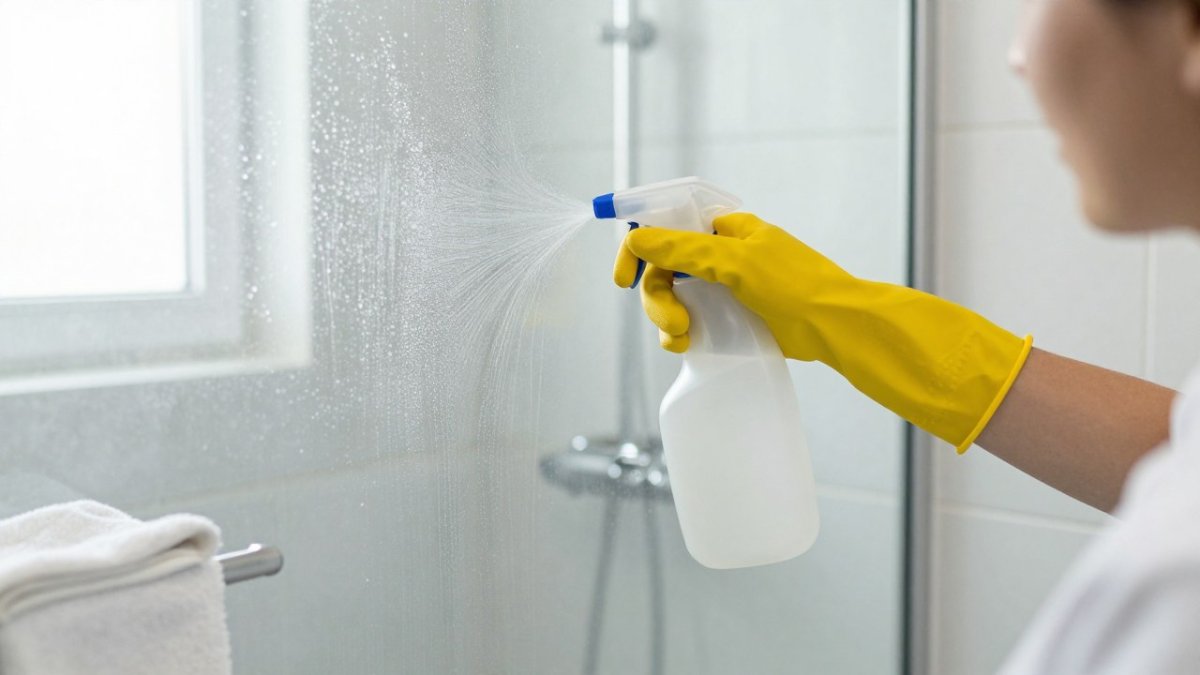
Glass shower doors. Use the 50/50 distilled white vinegar and water spray for maintenance and the three-to-one mix for set-in film.
Ceramic and porcelain tile. Both tolerate vinegar and citric acid well. Spray the 50/50 mix, dwell five to ten minutes, then wipe with a non-abrasive pad.
Grout. Grout is porous and holds minerals and soap residue together, so it needs a different approach than tile.
Natural stone (marble, travertine, limestone). Do not use vinegar, citric acid, or lemon juice on natural stone. These acids etch calcium-based stone, leaving dull patches that no cleaner reverses.
Chrome, stainless steel, and fixtures. Chrome and stainless steel handle vinegar well. Soak a cloth in the 50/50 mix, wrap it around the faucet or showerhead, and leave it twenty minutes for crusted spouts.
Acrylic and fiberglass surrounds. These tolerate mild vinegar solutions but can scratch with abrasive pads.
Rinse and wipe dry after every treatment. Drying is what stops the minerals from re-depositing, and it matters more than the strength of the cleaner.
Best Hard Water Stain Remover for Toilets: Tackling Mineral Rings
The best hard water stain remover for toilets is a citric acid or vinegar soak left overnight, because the ring sits above the waterline where sprays slide off. The fix is contact time, not force.
Start by shutting off the water and flushing to empty the bowl. That exposes the mineral ring directly. Apply a thick baking soda paste to the ring, then spray it with vinegar and let it fizz and sit for at least thirty minutes. For older rings, use a citric acid solution instead and leave it overnight.
Scrub with a pumice stone designed for toilets, keeping both the stone and the surface wet. Dry pumice scratches porcelain. Rust-colored stains respond to the same acid treatment, though they may need two rounds.
Do not use acid cleaners inside the tank. The parts inside are sensitive, and acid shortens their life. Keep the treatment in the bowl. Flush and rinse well when finished, then dry the rim so minerals do not settle again.
Best Hard Water Stain Remover for Glass: Windows and Shower Doors
The best hard water stain remover for glass is a 50/50 distilled vinegar and water spray with a short dwell, followed by a squeegee and a dry cloth. Glass shows every leftover mineral, so the drying step matters as much as the cleaning.
For exterior windows with heavy spotting, use the stronger three-to-one vinegar mix. Spray, wait five minutes, then wipe with a microfiber cloth. Avoid spraying on hot glass in direct sun; the solution dries too fast to work and can leave streaks.
Interior glass and mirrors do better with the milder mix. A common mistake is soaking glass too long with a strong acid, which can dull older panes and damage frames. Five to ten minutes is plenty for maintenance.
For shower glass specifically, a squeegee after every use prevents most of the problem. It takes fifteen seconds and removes the water before the minerals can dry.
Store-Bought vs. Homemade: What the Labels Don’t Tell You
Store-bought natural cleaners win on convenience; homemade mixes win on cost and control. The label rarely tells you which one actually suits your water, though, and it almost never warns you about the mixtures that can hurt you or cancel each other out.
Most “natural” or “eco” cleaners rely on the same acids you mix at home, typically citric acid or a mild surfactant. What you pay extra for is packaging, scent, and a ready-to-use bottle. That is a fair trade for some households and a waste for others.
What labels often omit is concentration. A cleaner listed as citric-acid-based may be dilute enough for daily wipe-downs but too weak for a set-in ring.
Ingredient combinations that go wrong. Two mixtures cause most of the trouble. First, never combine vinegar or citric acid with chlorine bleach. Second, combining baking soda with vinegar looks impressive because it fizzes, but the reaction neutralizes both ingredients into water and sodium acetate, which cleans far less effectively than either one used separately.
What “natural” actually means on a label. “Natural” is not a regulated claim on cleaning products. It tells you nothing about safety around children, pets, or sensitive surfaces. “Non-toxic” and “eco-friendly” are also loosely used; some products carry third-party certifications such as Safer Choice from the U.S.
Cost and control comparison. Homemade mixes give you exact control over concentration, which matters when your water is very hard and you need a stronger solution. If you would rather buy than mix, the guide to the best eco friendly cleaning products compares brands, refillable options, and cost per use.
If allergies run in your household, the eco friendly cleaning for family allergies guide covers which methods suit sensitive homes.
Preventing Hard Water Stains Before They Set
Prevention comes down to removing water before it evaporates, and it costs less effort than any cleaning routine. Three habits handle most of it.
- Squeegee shower walls and glass after every use. Fifteen seconds beats thirty minutes of descaling.
- Wipe fixtures dry with a microfiber cloth. Faucets and showerheads show spotting first.
- Run a weekly acid spray on high-traffic surfaces. The 50/50 vinegar mix is enough when nothing has set.
Beyond habits, a few upgrades help. A shower squeegee mounted inside the enclosure gets used; one stored in a cabinet does not. Sealing grout and natural stone once a year slows mineral penetration. If your water is very hard, a whole-house softener reduces the mineral load before it ever reaches a fixture, which changes the cleaning math entirely.
Track your results for a month. If spotting returns within days despite weekly cleaning, your water hardness is likely above 180 mg/L and your routine needs to be more aggressive.
When to Bring in Professional Help for Hard Water Buildup
Call a professional when the buildup has moved past film and into etching, or when the surfaces at risk are ones you cannot afford to damage. Glass that looks permanently cloudy is usually etched, and no cleaner reverses that.
Signs it is time to bring someone in:
- Glass or tile stays cloudy after a full acid treatment
- Grout lines are dark and no longer respond to brushing
- Mineral crust has formed around fixtures and behind the toilet base
- Natural stone surfaces show dull patches or etching
- You have tried the recipes here for a month with no visible change
Etched glass and damaged stone need a different approach than cleaning, and aggressive DIY scrubbing can make both worse. A deep clean that targets built-up mineral scale across the whole bathroom is often the faster route. You can book a deep cleaning service that covers the fixtures, tile, and grout in one visit, and contact our team if you are unsure whether your buildup needs a standard clean or something heavier.
For the broader health and household case for natural cleaning, the benefits of eco-friendly home cleaning are worth a read before you decide how far to take it.
Hard water is a maintenance problem, not a cleaning emergency, and the households that stay ahead of it clean less overall. Bettermark Home & Property Services, LLC can handle that maintenance for busy homeowners, with eco-conscious product options available on request. Booking runs through a mobile-friendly system, so you can schedule or reschedule around your week. Get started with Bettermark and keep your glass, tile, and fixtures clear without spending your weekends scrubbing.
Frequently Asked Questions
What removes hard water stains naturally?
White vinegar and citric acid are the two most effective natural options. For light water spots, spray a 1:1 mix of distilled white vinegar and water, let it sit for 5-10 minutes, then wipe. For stubborn calcium deposits, make a paste of baking soda and water, apply it to the stain, and scrub with a non-abrasive pad. Lemon juice works similarly to vinegar. Always test on a hidden spot first, since acids can etch natural stone and some tile grout.
What is a good homemade shower cleaner for hard water?
Mix one cup of distilled white vinegar with one cup of water in a spray bottle, add a teaspoon of dish soap to help the solution cling to vertical surfaces, and spray the shower doors, tile, and fixtures. Let it dwell for 10 minutes, scrub grout lines with a soft brush, and rinse. For heavy soap scum mixed with mineral buildup, follow with a baking soda paste. Avoid this recipe on natural stone like marble or travertine, which acids can damage.
Will vinegar get rid of hard water buildup?
Vinegar dissolves calcium and magnesium deposits, so it handles fresh water spots and light limescale well. Heavy, years-old buildup often needs a longer dwell time, a stronger acid like citric acid, or mechanical action from a pumice stone on porcelain toilets. Vinegar should not be used on natural stone, aluminum, or cast iron. It also should never be mixed with bleach, because the combination releases chlorine gas.
Are store-bought natural hard water cleaners effective?
Many store-bought cleaners labeled natural rely on the same acids found in homemade recipes, typically citric acid or vinegar, sometimes with surfactants added to help them cling to surfaces. They cost more per use but save time and come pre-mixed at consistent concentrations. Check the ingredient list for chelating agents like gluconic acid, which target mineral deposits specifically. For routine maintenance, homemade solutions can be effective; for set-in stains, a formulated product may work differently.
