Eco Friendly Cleaning for Family Allergies: A Guide
Last Updated: November 4, 2026
Quick Summary
Eco friendly cleaning for family allergies means using plant-based, fragrance-free products that minimize synthetic chemicals, VOCs, and fragrance while still removing allergens from surfaces. Wash bedding weekly in hot water, HEPA-vacuum twice weekly, and damp-wipe surfaces every two to three days. Choose fragrance-free over unscented, and look for the EPA Safer Choice label.
- Dust mites hide in bedding, pillows, and carpet; remove them with hot-water washing and HEPA vacuuming.
- Avoid SLS, phthalates, VOCs, bleach, ammonia, and quats, which leave residues and release irritating fumes.
- Unscented products may contain masking fragrances, so look for fragrance-free on the label.
- Homemade vinegar sprays clean everyday messes but do not disinfect; use an EPA-registered product for germ-heavy jobs.
- Never mix vinegar with bleach, because the combination releases chlorine gas.
Table of Contents
- Why Eco Friendly Cleaning Matters for Allergy Relief
- Common Household Allergens and Where They Hide
- Ingredients to Avoid in Cleaning Products
- Fragrance-Free Cleaning Products for Sensitive Households
- Dust Mite Avoidance: Cleaning Routines That Actually Work
- Homemade Eco-Friendly Cleaning for Family Allergies
- Pet-Specific Allergy Considerations Most Guides Skip
- Budget-Friendly vs. Premium Eco-Product Comparison
- Book an Eco-Conscious Cleaning Service That Fits Your Family
- Frequently Asked Questions
Why Eco Friendly Cleaning Matters for Allergy Relief
Eco friendly cleaning for family allergies starts with one uncomfortable fact: the products meant to protect your home can aggravate the symptoms you are trying to stop. Many families find that switching to plant-based formulas and fragrance-free options reduces everyday respiratory irritation, though results vary by household.
Eco friendly cleaning is the practice of using products and methods that minimize synthetic chemicals, volatile organic compounds, and fragrance, while still removing allergens from surfaces. The goal is not just a cleaner home but a calmer immune system. Chemical residues left on counters and floors can linger long after the smell fades.
The American Lung Association’s guidance on indoor air quality notes that indoor air can carry higher concentrations of some pollutants than outdoor air. That matters for a family with allergies, because you spend most of your time indoors.
Common Household Allergens and Where They Hide
Dust mites, pet dander, mold spores, and pollen are the four allergens most families battle, and each one settles in predictable places. Dust mites concentrate in bedding, upholstery, and carpet fibers. Pet dander clings to soft surfaces and travels through HVAC systems. Mold prefers bathrooms, basements, and anywhere moisture collects. Pollen rides in on shoes and clothing and lands on entryway floors.
A common mistake is cleaning visible surfaces while ignoring the reservoirs. A spotless kitchen counter means little if the curtains and sofa cushions are holding a season’s worth of dander.
| Allergen | Where It Hides | Best Removal Method |
|---|---|---|
| Dust mites | Bedding, pillows, carpet | Hot-water washing, HEPA vacuuming |
| Pet dander | Upholstery, curtains, vents | Microfibre wiping, frequent laundering |
| Mold spores | Bathrooms, basements, grout | Moisture control, white vinegar |
| Pollen | Entryways, floors, shoes | Damp mopping, doormats, rinse-free mopping |
Ingredients to Avoid in Cleaning Products
Certain ingredients appear again and again on labels and deserve a second look from any allergy-conscious household. The problem is not that these ingredients are always dangerous in isolation; it is that they leave residues on surfaces your family touches and release fumes into the air your family breathes. For a household managing allergies, that combination matters more than the dose on any single cleaning day.
Here is what to watch for and why each one earns a place on the avoid list:
- Sodium lauryl sulfate (SLS) and sodium laureth sulfate (SLES). These are foaming agents that make cleaners feel like they are working. They are surfactants, which means they lower surface tension so water can lift dirt, but they also strip oils from skin and can irritate airways when sprayed. A common pattern is a family member who sneezes or coughs during bathroom cleaning and assumes it is the bleach when the foaming agent is the culprit.
- Phthalates. These are used to make fragrance last longer on a surface. They are not usually listed by name; they hide inside the word “fragrance” on the ingredient panel. Phthalates are associated with respiratory irritation, and because they are semi-volatile, they can linger in indoor air after the smell fades.
- Volatile organic compounds (VOCs). This is a broad category that includes solvents, some fragrances, and ingredients like formaldehyde releasers. VOCs evaporate at room temperature, which is exactly why they reach your lungs. The EPA notes that some cleaning products are a source of VOCs indoors, and for an asthma sufferer, a VOC-heavy cleaner can act as a trigger even when the product is labeled “green.”
- Bleach (sodium hypochlorite) and ammonia. Both produce fumes that bother sensitive lungs, and mixing them creates chloramine gas, which is genuinely dangerous. Even used separately, they are harsh enough that many allergy-focused households keep them out of everyday cleaning and reserve them for targeted disinfection.
- Quaternary ammonium compounds (quats). Common in disinfecting wipes and sprays, quats are effective against germs but are known respiratory and skin irritants. If a product says “kills 99.9% of germs” and lists a quat, it may not be the right everyday choice for a sensitive household.
The EPA’s Safer Choice program identifies products that meet its safety criteria, which gives shoppers a shortcut when reading labels. Watch out: “natural,” “green,” and “eco” are marketing words, not regulated claims, so a bottle can say any of them without meeting a standard. The Safer Choice label is one of the few third-party marks that requires ingredient review.
Read the ingredient list, not the front label. If a product lists “fragrance” without naming the components, treat it as a black box. If it lists “proprietary blend” or “inert ingredients” without detail, assume the worst case for a sensitive household and look for a product that discloses more. A practical shortcut is to scan for the words “fragrance-free” (not “unscented”), “SLS-free,” and “VOC-free” on the panel, then confirm the product carries a Safer Choice mark or a full ingredient disclosure. That combination filters out most of the offenders above before you ever get to the checkout.
Fragrance-Free Cleaning Products for Sensitive Households
Fragrance-free cleaning products skip added scent entirely, which many households with asthma, chemical sensitivity, or young children prefer. “Unscented” is not the same as fragrance-free: unscented products may contain masking fragrances to neutralize a chemical smell. Look for the words “fragrance-free” on the label.
For everyday surface sanitation, a fragrance-free plant-based cleaner handles most messes. For germ-heavy areas, check that the product carries an EPA-registered claim rather than assuming any spray disinfects.
Dust Mite Avoidance: Cleaning Routines That Actually Work
Dust mite avoidance comes down to frequency and heat, not intensity. Wash bedding weekly in hot water, vacuum with a HEPA filter, and wipe surfaces with a damp microfibre cloth rather than a dry one that sends dust airborne.
A practical routine looks like this:
- Wash bedding and pillowcases weekly in hot water
- Vacuum carpets and upholstery with a HEPA vacuum twice weekly
- Damp-wipe hard surfaces every two to three days
- Launder curtains and throw blankets monthly
- Keep indoor humidity low with ventilation or a dehumidifier
If you want a fuller room-by-room schedule, our guide on the best ways to keep home clean lays out a daily and weekly routine you can follow.
Homemade Eco-Friendly Cleaning for Family Allergies
Homemade cleaners work well when you stick to a few proven ingredients and understand what each one actually does. Most guides hand you a recipe and move on; the difference for an allergy household is knowing the mechanism, because a cleaner that merely spreads allergens around is worse than no cleaner at all.
Here is the chemistry behind the four workhorses, and where each one stops working:
- White vinegar (acetic acid, roughly 5% in household strength). The acid dissolves mineral deposits and cuts light grease, and it is effective against some mold species on non-porous surfaces. It is not a disinfectant at household concentration for most pathogens, and it does not kill dust mites. Its real value in an allergy routine is as a residue-free surface wipe that does not leave fragrance behind.
- Baking soda (sodium bicarbonate). It is a mild abrasive and an odor absorber, not a disinfectant. It scours gently without scratching most surfaces and neutralizes acidic soils. It does not remove dander or mite allergen; it lifts and carries them so a damp cloth can take them away.
- Castile soap. A plant-based surfactant made from olive or other vegetable oils. It lifts dirt and oil into water so they can be rinsed away, which is the same job synthetic surfactants do, minus the fragrance and harshness. It is not a disinfectant and should not be used on surfaces that need sanitizing.
- Borax (sodium tetraborate). It boosts cleaning power in laundry and can help break down soils, but it is not a disinfectant and it should be kept away from pets and small children. It is also not a substitute for hot water when the goal is mite allergen removal.
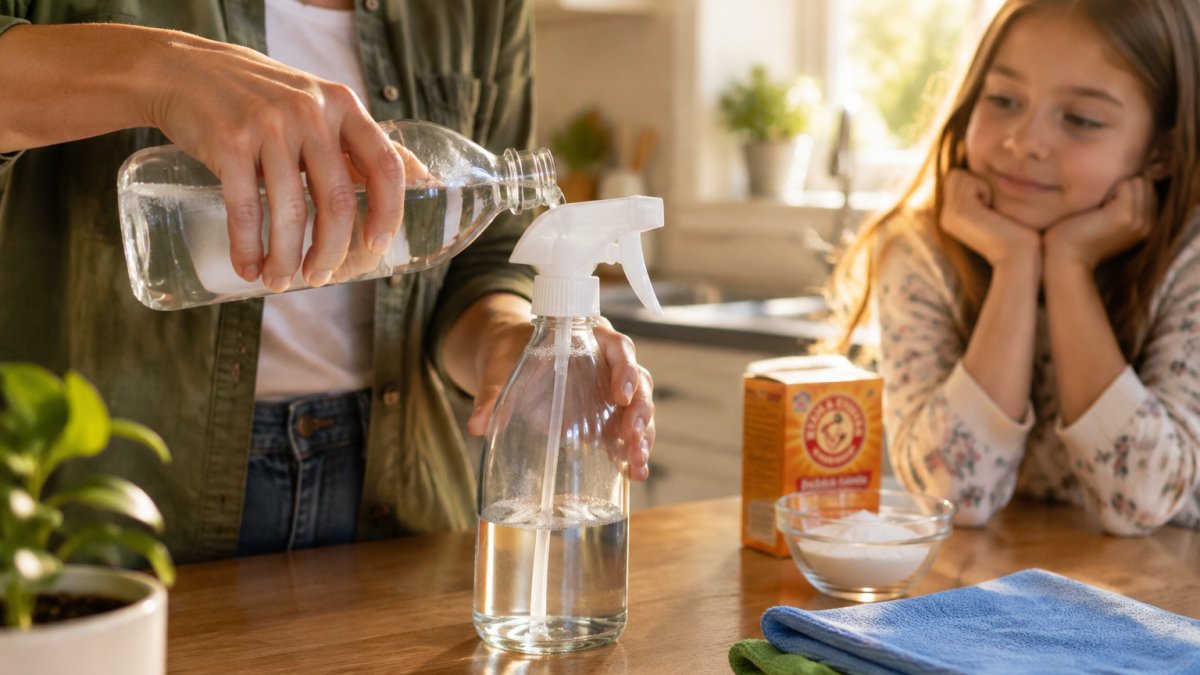
A basic all-purpose spray: mix equal parts white vinegar and water in a spray bottle, add a few drops of castile soap, and shake before use. For a scouring paste, combine baking soda with enough water to form a thick consistency. These recipes avoid synthetic fragrances and harsh solvents entirely, which is the main allergy benefit: you control every ingredient that touches the surface.
What DIY does not do is disinfect. If someone in the house has a compromised immune system or you are dealing with raw meat juices, a homemade spray is not a substitute for an EPA-registered disinfectant. The practical split most allergy households settle into is DIY for everyday dusting, mopping, and degreasing, and a fragrance-free EPA-registered product for germ-heavy jobs.
Watch out: vinegar should not go on natural stone like granite or marble, because the acid etches the surface, and it should not be mixed with bleach, because the combination releases chlorine gas. Keep homemade sprays labeled and out of reach of children, and make a fresh batch every couple of weeks since there is no preservative keeping bacteria out of a water-based spray.
Pet-Specific Allergy Considerations Most Guides Skip
Pet owners face a double bind: the dander that triggers allergies also clings to every surface a pet touches, and some cleaning products irritate pets as much as people. Most guides treat pet allergies like human allergies, but the practical steps differ.
Pets walk through chemical residues and then groom themselves, ingesting whatever is on their paws. Rinse-free formulas and fragrance-free products reduce that exposure. Vacuum pet beds and favorite resting spots weekly, and wash pet bedding on the same hot-water schedule as your own. Wipe down hard floors with a damp microfibre mop to lift dander rather than scattering it.
If your pet shows itching or sneezing after a cleaning day, consider switching to a fragrance-free option and check with your veterinarian if symptoms persist.
Budget-Friendly vs. Premium Eco-Product Comparison
Price does not always track with safety, and the cheapest eco-product can outperform a premium one on the metrics that matter for allergies. What separates budget from premium is usually concentration, certification, and packaging rather than cleaning power.
| Factor | Budget-Friendly | Premium |
|---|---|---|
| Cost per use | Lower upfront, often diluted | Higher upfront, concentrated |
| Certifications | Rarely third-party certified | Often EPA Safer Choice or similar |
| Packaging | Plastic bottles | Refillable or concentrated tablets |
| Fragrance control | Basic fragrance-free options | Extensive fragrance-free lines |
| Best for | Tight budgets, simple messes | Chemical sensitivity, refill habits |
Concentrates often cost less per use than ready-to-use bottles once you dilute them, even when the sticker price looks higher. For a deeper comparison of specific brands, refill options, and cost-per-use value, see our guide to the best eco friendly cleaning products.
Book an Eco-Conscious Cleaning Service That Fits Your Family
Handing off the work makes sense when allergies demand a level of consistency that busy schedules cannot sustain. A professional service can maintain the dust mite routine, use fragrance-free products on request, and keep every surface on schedule without you lifting a cloth.
Bettermark Home & Property Services, LLC offers eco-conscious product options upon request, background-checked and screened cleaning providers, and a satisfaction guarantee with free re-cleaning. Our mobile-friendly booking system makes scheduling convenient. We are a family-owned business. For ongoing support, explore our recurring cleaning options, or get your quote and book online for current pricing and availability for your home.
If you want the deeper case for going green before you commit, our article on the real benefits of eco-friendly home cleaning covers the health and environmental upside in more detail.
Frequently Asked Questions
What is the least toxic house cleaner for allergy-prone families?
Plain white vinegar, baking soda, and castile soap are among the least toxic options for routine cleaning. Vinegar handles most hard-surface sanitation, baking soda lifts grime and absorbs odors, and castile soap cuts grease. Look for products labeled fragrance-free and free of volatile organic compounds, and check whether a disinfectant is EPA-registered if you need verified germ kill. For families with chemical sensitivity, start with the simplest formula and add nothing you do not need.
Can natural cleaning products still trigger allergies?
Yes. Essential oils, citrus solvents, and even plant-based surfactants can cause respiratory irritation or contact reactions in sensitive people. Natural does not automatically mean hypoallergenic. If someone in your home has asthma or chemical sensitivity, choose fragrance-free formulas, ventilate while cleaning, and test any new product in one room before using it throughout the house. Watch for symptoms during and after use, not just at the moment of application.
How often should I clean to reduce indoor allergens?
Weekly cleaning covers most households: vacuum with a HEPA filter, damp-wipe surfaces, and wash bedding in hot water. Dust mite avoidance usually calls for bedding washes every one to two weeks. Homes with pets or a family member with asthma may need vacuuming two to three times per week in bedrooms and living areas. High-traffic rooms and bathrooms benefit from more frequent attention than guest rooms.
Are fragrance-free cleaning products better for asthma and allergies?
For most allergy-sensitive households, yes. Synthetic fragrances are a common source of volatile organic compounds and a frequent asthma trigger. Fragrance-free products remove that exposure without sacrificing cleaning power, since the scent adds nothing to how well a product works. If you want a light scent, ventilate the room and choose products that list no added fragrance rather than masking odors with stronger perfumes.
What smells keep dust mites away?
No scent reliably keeps dust mites away. Dust mites are microscopic and respond to moisture and food sources, not smell. Essential oils may make a room feel fresher but do not reduce mite populations and can irritate airways. What works is lowering indoor humidity, washing bedding in hot water, using mite-proof covers, and vacuuming with a HEPA filter regularly. Focus on moisture control and physical removal rather than scent.
Do eco-friendly cleaning services really use safer products?
Reputable services should tell you exactly which products they use and offer fragrance-free options on request. Ask before booking whether eco-conscious products are standard or an add-on, and whether the same cloths and equipment are used across homes. A service that is transparent about its screening and re-clean policies is usually easier to hold accountable than one that only markets green claims without specifics.
Your family’s allergies deserve a cleaning routine built around them, not a generic checklist. Bettermark Home & Property Services, LLC brings eco-conscious products, vetted cleaners, and a satisfaction guarantee to every visit, so you can stop worrying about what is left behind on your counters. Get started with Bettermark Home & Property Services, LLC and book a clean that respects your family’s health.
