How Do You Keep an Office Clean Every Day?
Last Updated: November 1, 2026
Quick Summary
To maintain a clean office, run a 15-minute morning reset for desks, counters and trash, then close with about ten minutes of end-of-day tasks like wiping shared keyboards and clearing food. Daily habits handle fast-building mess, while weekly and monthly tasks handle the rest.
- A two-minute disinfecting wipe pass at the start and end of day covers high-touch surfaces.
- Sweep hard floors daily in high-traffic areas, vacuum carpets weekly, and mop once a week at minimum.
- Empty trash and recycling daily in shared areas and weekly at individual desks.
- Check restroom supplies twice a day and wipe handles and faucets.
- Score each zone 1 to 3 in a ten-minute weekly walk-through and assign fix dates.
Table of Contents
- Build a Daily Office Cleaning Routine That Actually Gets Done
- Your Office Cleaning Checklist: Desks, Shared Equipment, and High-Touch Surfaces
- Set an Office Cleaning Schedule by Frequency and Area
- Floors, Trash Bins, and Break Room Spills: The Weekly Heavy Lifting
- Office Hygiene Practices That Protect Employee Health
- Choose Cleaning Supplies Safely and Keep Them Accessible
- How to Measure Office Cleanliness and Hold Everyone Accountable
- Book a Commercial Cleaning Assessment for Your Workplace
- Frequently Asked Questions
Build a Daily Office Cleaning Routine That Actually Gets Done
Most office cleaning plans fail for one reason: they are too ambitious for a busy Tuesday. A workspace stays healthy when small tasks happen every day, not when a deep clean happens once a quarter. This guide shows you how to maintain a clean office environment with routines short enough that people actually finish them.
The core idea is simple. Daily habits handle the mess that builds up fast. Weekly and monthly tasks handle the rest. Split the work that way and a clean office stops being a project and becomes a habit.
Here is what most guides get wrong. They hand you a 40-item checklist and no schedule. A list without timing is just guilt. So we build this around time blocks instead.
The 15-Minute Morning Reset
Start the day with a quick pass before the work piles up. Fifteen minutes is enough when you split it across the team.
- Clear desks of cups, wrappers, and paper clutter.
- Wipe the coffee station and break room counters.
- Spot-check restrooms for paper towels and soap.
- Empty the most-used trash bins.
- Open blinds and check that airflow is not blocked.
The morning reset works because it happens before mess compounds. A common mistake is saving all of this for the end of the day, when energy is gone and people rush out the door.
Closing Tasks That Set Up Tomorrow
End-of-day tasks take about ten minutes and make the morning easier. Assign them to whoever closes the office.
- Wipe down shared keyboards and mice
- Clear food from desks and the break room fridge
- Take out food waste so it does not sit overnight
- Stack chairs and clear walkways
- Note any supply that ran low
That last item matters more than it looks. A running supply note stops the “we ran out of paper towels” scramble that derails a routine.
Your Office Cleaning Checklist: Desks, Shared Equipment, and High-Touch Surfaces
An office cleaning checklist should cover three zones: personal desks, shared equipment, and the surfaces everyone touches. High-touch surfaces include door handles, light switches, shared keyboards, printers, and coffee machine buttons. These spread germs faster than any floor.
Desks, Keyboards, and Sensitive Electronics
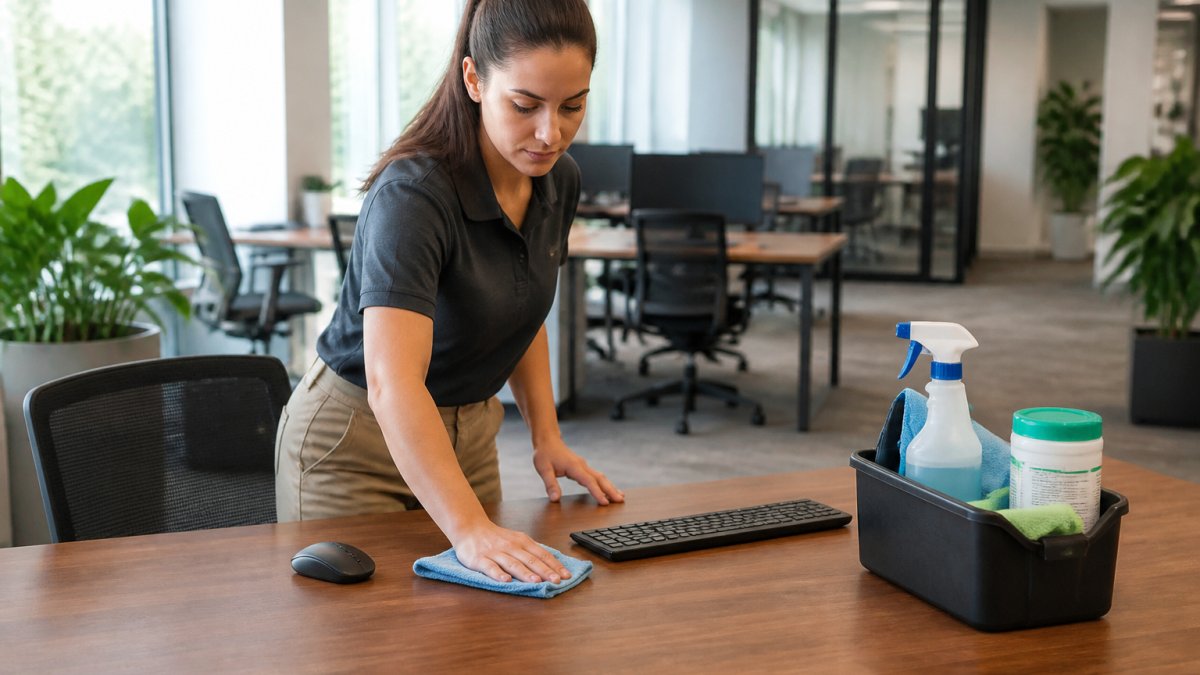
Desks collect crumbs, dust, and fingerprints daily. A quick wipe with a microfiber cloth handles most of it.
Electronics need more care, and this is where most office cleaning advice stops short.
Keyboards and mice. Shake crumbs out first by turning the keyboard upside down and tapping it gently. Wipe key tops and the mouse shell with a barely damp microfiber cloth.
Monitors and screens. Use a dry or slightly damp microfiber cloth, paper towels can scratch anti-glare coatings. Wipe in one direction, and let the screen dry fully before powering back on.
Phones and headsets. These touch faces and hands all day, so they deserve a daily wipe.
Printers and copiers. Wipe the exterior and the glass platen with a dry microfiber cloth. Do not spray cleaner into paper trays or vents.
Shared tablets and touchscreens. Wipe with a microfiber cloth dampened with water or a screen-safe cleaner. Avoid abrasive pads and ammonia-based cleaners unless the device maker approves them.
Never spray liquid directly on a keyboard, monitor, printer, or phone. Soaking a device is the fastest way to turn a cheap cleaning task into a replacement cost. Dampen the cloth, never the device.
For shared equipment, set a rule: one wipe-down per shift change. It takes seconds and keeps shared tools from becoming a hygiene problem. Keep a small caddy of microfiber cloths and device-safe wipes near the shared equipment so the task is never more than an arm’s reach away.
High-Touch Surfaces: The Two-Minute Pass
High-touch surfaces are the ones hands land on without thinking: door handles, light switches, shared keyboards, printer buttons, coffee machine controls, faucets, and refrigerator handles. A two-minute pass with a disinfecting wipe at the start and end of the day covers most of them. Focus on the surfaces people touch after washing their hands, and the ones they touch before.
A common pattern is to clean visible mess and skip the invisible high-touch points. The checklist should name them explicitly so they do not get overlooked.
Set an Office Cleaning Schedule by Frequency and Area
A workable office cleaning schedule splits tasks by how often they need doing. Daily items keep the space livable. Weekly items keep it healthy. Monthly and quarterly items protect the building itself.
| Frequency | Areas and Tasks | Who |
|---|---|---|
| Daily | Desks, high-touch surfaces, trash, break room counters, spills | All staff |
| Weekly | Floors, restrooms deep wipe, fridge clean-out, dusting | Assigned staff or vendor |
| Monthly | Vents, baseboards, windows, supply inventory | Facilities lead |
| Quarterly | Carpet deep clean, upholstery, storage purge | Professional crew |
Post this schedule where people see it. A schedule nobody reads is the same as no schedule. If you are weighing in-house routines against hiring help, this comparison of commercial janitorial services vs residential cleaning breaks down scope, schedules, and contracts.
Floors, Trash Bins, and Break Room Spills: The Weekly Heavy Lifting
Floors take the most abuse in any office. Sweep hard floors daily in high-traffic areas, vacuum carpets weekly, and mop once a week at minimum. Entryways need more attention because grit gets tracked in and scuffed into the carpet.
Trash and recycling bins should be emptied daily in shared areas and weekly at individual desks. Keep recycling bins next to trash bins so people sort without thinking.
Break room spills need immediate action, not a weekly pass. Blot liquids with an absorbent cloth right away, then clean the spot. Food waste belongs in a covered bin and out of the office daily.
Office Hygiene Practices That Protect Employee Health
Good office hygiene practices reduce sick days and keep the workplace comfortable. The basics are unglamorous but effective:
- Wash hands often, especially before eating
- Keep hand sanitizer at shared stations
- Clean shared equipment between users
- Store food properly and label leftovers
- Stay home when sick
Restroom hygiene deserves its own routine. Check supplies twice a day and wipe high-touch points like handles and faucets. A restroom that runs out of soap by noon tells employees the whole building is an afterthought.
Airflow matters too. Do not block vents with boxes or furniture. Open windows when weather allows, and change filters on schedule.
Choose Cleaning Supplies Safely and Keep Them Accessible
Safe supplies start with reading the label. Follow dilution directions exactly, never mix products, and keep chemicals in original containers. Store them away from food and out of reach of visitors.
Keep supplies accessible, not locked in a closet nobody wants to open. A small caddy on each floor with microfiber cloths, a neutral cleaner, and gloves removes the excuse to skip a task.
Watch out: mixing bleach with an acid-based cleaner releases dangerous gas. If you are unsure whether two products can be combined, use one at a time.
How to Measure Office Cleanliness and Hold Everyone Accountable
What gets checked gets done. Measure cleanliness with a simple weekly walk-through and a short score sheet. Rate each zone on a scale, note problems, and assign a fix with a deadline.
A score sheet only works if it is short enough to finish in ten minutes. Here is a practical format: list each zone (desks, shared equipment, break room, restrooms, floors, entryway) and score it 1 to 3, 1 means a problem was found, 2 means acceptable, 3 means clean and stocked. Add one line for notes and one for the owner’s name. Anything scored 1 gets a fix date before the walk-through ends.
A simple completion log works alongside the score sheet. Post a printed log or a shared spreadsheet where each zone owner initials the date a task was done. The log does two things: it shows whether routines are actually happening, and it surfaces patterns, a zone that is consistently late usually has an owner who is overloaded, not careless.
Accountability works best when it is shared. Give each team a zone, rotate the inspection duty so no one person is always the enforcer, and review results in a brief weekly huddle. Keep the huddle to five minutes: what scored low, who owns the fix, and when it will be done. Learn more about A Better Business Space.
Rotate the inspector role monthly. When everyone inspects, everyone notices what a clean zone looks like, and the standard spreads faster than a written policy.
For teams that want a starting point, a one-page inspection checklist with the six zones above, a 1-to-3 scale, and a fix-date column is enough. Add detail only when a specific problem keeps recurring.
Book a Commercial Cleaning Assessment for Your Workplace
Daily habits carry most of the load, but some tasks need a professional crew with the right equipment and time. That is where we come in.
Bettermark Home & Property Services, LLC is a family-owned business serving commercial clients with customized cleaning plans. Our background-checked, screened providers handle the heavy work, and our satisfaction guarantee includes free re-cleaning if something falls short. Book through our mobile-friendly system and reschedule on the fly when your week changes. Eco-conscious product options are available on request.
Ready to hand off the heavy lifting? Contact us with questions about which plan fits your space. Commercial Cleaning Contact us with questions about which plan fits your space.
Frequently Asked Questions
How often should an office be cleaned?
High-touch surfaces like doorknobs, light switches, and shared keyboards should be wiped daily, and desks should be cleared and wiped at the end of each shift. Floors, trash bins, and break room appliances need weekly attention, while deep tasks such as carpet extraction and vent dusting fit a monthly or quarterly schedule. Building a clean office comes down to matching frequency to how many people touch each surface.
What should be included in a daily office cleaning checklist?
A workable daily checklist covers wiping desks and shared equipment, disinfecting high-touch surfaces such as door handles and light switches, emptying trash and recycling bins, spot-cleaning kitchen spills, and a quick sweep or vacuum of entryways. Keep the list short enough to finish in 15 to 20 minutes so it actually gets done, and leave floors, restrooms, and deep cleaning for the weekly rotation.
How can employees help keep a shared office clean?
Give each employee ownership of their own workstation and one shared zone, such as the printer area or coffee station. Provide accessible cleaning supplies, set a clear expectation that desks are cleared before leaving, and post the office cleaning schedule where everyone can see it. When tasks are assigned and visible, hygiene practices stop depending on one person’s goodwill.
Which office areas should be cleaned most often?
Door handles, light switches, shared keyboards, printer touchscreens, faucets, and break room counters collect the most hand contact and should be disinfected daily. Restrooms and kitchens need at least daily attention with restocking. Desks and personal items fall to each employee, while floors and windows can follow a weekly or monthly cadence depending on foot traffic.
Keeping an office clean every day is less about effort and more about a routine that survives a busy week. If your team would rather focus on work than floors and restrooms, Bettermark Home & Property Services, LLC can take over the recurring tasks with background-checked providers, a satisfaction guarantee with free re-cleaning, and eco-conscious product options. Get started with Bettermark Home & Property Services, LLC and give your workplace a consistently clean space.
